

OtterlyAI Releases Study on German AI Search Citations: 64.9% Linked to German Addresses
New OtterlyAI study of 3.95 million citations across seven AI search engines: consumer-test publishers and industry associations shape German AI Search. International competitors do not need a .de domain to get in.
Persenbeug, LOWER AUSTRIA, Oct. 06, 2026 (GLOBE NEWSWIRE) -- Anyone who wants to be visible in AI answers in Germany is competing mostly against German sources. 64.9% of all citations that AI search engines return on German prompts point to an address carrying a German language or region signal. In the United States the comparable figure is 5.3%.
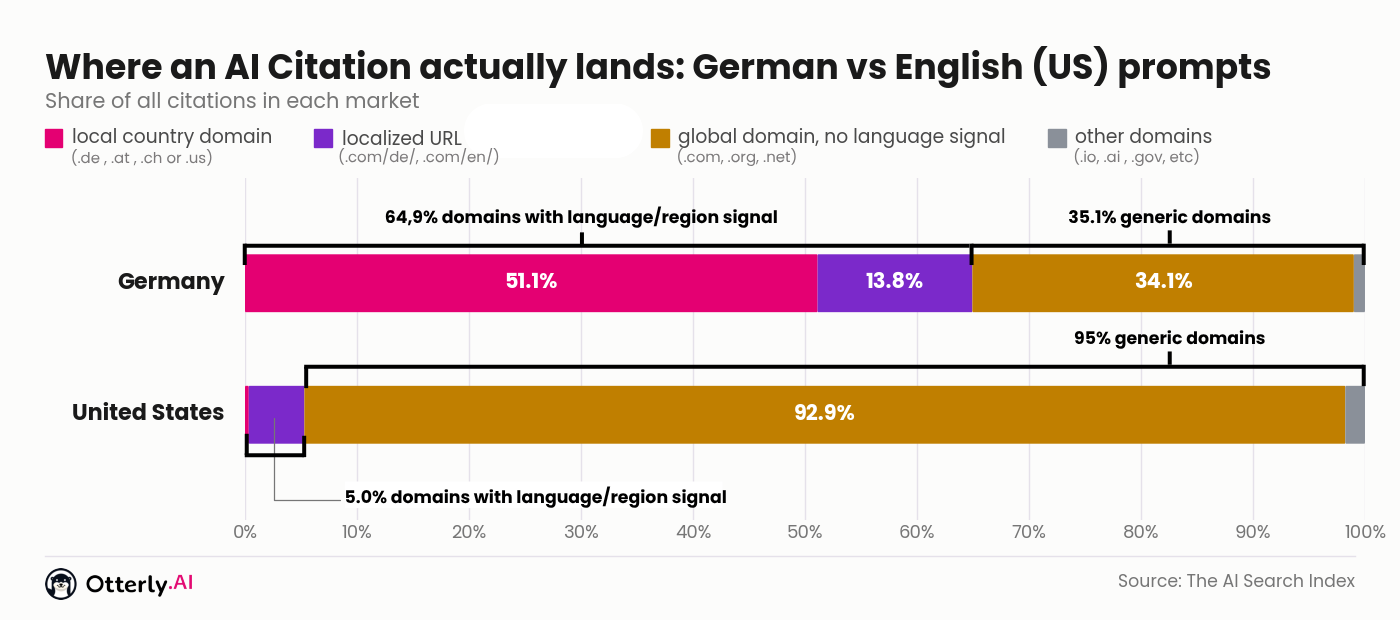
64.9% of all citations that AI search engines return on German prompts point to an address carrying a German language or region signal
That is the finding of The AI Search Index (Germany), a study by OtterlyAI, the leading AI search optimization platform. It covers 3.95 million citations across seven AI search engines, 44 days and 16 industries.
Associations, not government bodies
German AI Search leans on different institutions than the American one. Associations and NGOs take 8.9% of all German citations, against 5.3% in the United States. Behind the German figure are names every marketing team knows: Verbraucherzentrale, ADAC, the vfa, KfW and the IHK network. The cited media are different too. Finanztip, Chip, Handelsblatt and Test.de lead the German list, while the American one is led by Forbes, CNBC, Bankrate and NerdWallet.
The localized URL is the way in
51.1% of German citations go to a .de, .at or .ch address. Another 13.8% go to global domains that carry a German signal in the URL, such as a path like /de/ or a subdomain like de.statista.com.
For German companies the first figure is the good news and the second is the one to watch. An international competitor does not have to buy a German domain to appear next to a German provider. It needs a URL that contains a German language/regional signal on a domain that already has authority. In the United States that route barely matters: 5.0% of all citations there sit on a localized URL, against 13.8% in Germany.
Level of German source preference when asked German questions
Ask an AI search engine a question in German and 64.9% of what it cites back carries a German address, either a .de, .at or .ch domain or a global domain on a German URL. Every one of the seven engines studied leans this way, from 75.2% at Perplexity down to 57.7% at Claude.
For international marketing teams that means that localization is important in your strategy if you want to be cited in AI Search. For US English prompts, the same measure sits between 3.6% and 9.4%, where the AI Search Engine barely matters.
Reddit is not a German channel
Reddit carries 0.60% of German citations and 1.79% of American ones, roughly a third of the weight. YouTube is close to level in both markets, 1.99% in Germany and 1.75% in the United States.
Industry matters as well. In healthcare, 73% of German citations go to local domains; for education platforms it is 31%.
"More than 40,000 marketing professionals use OtterlyAI to measure their visibility in AI search, and the question we hear most from German teams is whether American GEO advice applies here at all. This data says a lot of it does not. Reddit carries a third of the weight, and associations count for more than government bodies. Those are different plays," says Thomas Peham, CEO and co-founder of OtterlyAI.
"So, here's the good and bad news for German brands: Local companies may not necessarily hold an advantage over international competitors that are offering German content on their .com domains. However, German companies and brands do enjoy a significant home advantage if they have mastered both on-page content and off-page signal optimization by actively engaging with local communities, news outlets, and trade websites."
Methodology
Window 16 August to 28 September 2026, 44 days, identical dates in both markets. The study covers the 16 industries tracked in both Germany and the United States.
3.95 million German and 3.73 million American citations, collected at URL level. Seven AI search engines: ChatGPT, Google AI Overviews, Google AI Mode, Gemini, Perplexity, Microsoft Copilot and Claude. The underlying prompts are commercial buying-intent questions, around one hundred per industry.
The full study with all industry figures is available at insights.otterly.ai/industry-reports.
About OtterlyAI
OtterlyAI is the leading AI search optimization platform. Marketing teams, SEO professionals and agencies use it to measure how their brands appear in AI-powered search experiences, including ChatGPT, Google AI Overviews, Google AI Mode, Gemini, Perplexity, Microsoft Copilot and Claude. More than 40,000 marketing professionals use OtterlyAI (as of August 2026).
The company was co-founded in 2024 by Thomas Peham, Klaus-M. Schremser and Josef Trauner, holds a technology partnership with Semrush, and was named a Cool Vendor in the 2025 Gartner Cool Vendors in AI in Marketing report. OtterlyAI is a fully remote company; the legal entity OtterlyAI GmbH is registered in Austria.
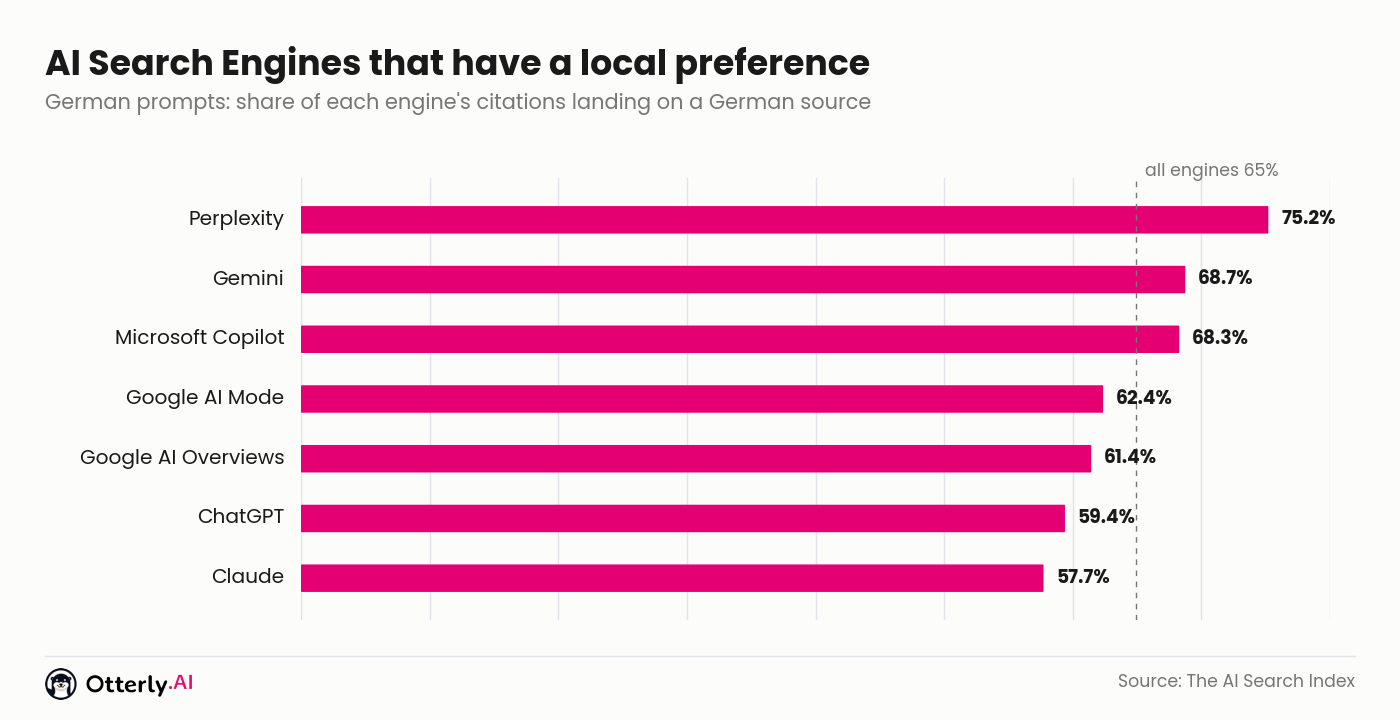
Each AI Search Engine has a level of local source preference
Press Inquiries
Thomas Peham
thomas.peham [at] otterly.ai
https://otterly.ai/

Legal Disclaimer:
EIN Presswire provides this news content "as is" without warranty of any kind. We do not accept any responsibility or liability for the accuracy, content, images, videos, licenses, completeness, legality, or reliability of the information contained in this article. If you have any complaints or copyright issues related to this article, kindly contact the author above.
